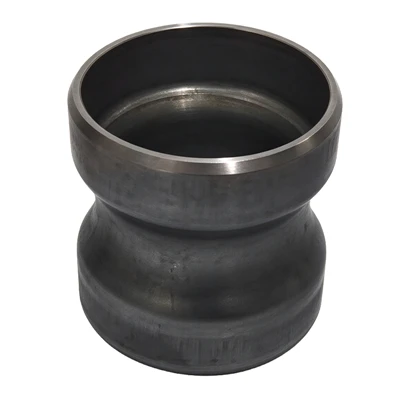

The primary function of an automotive lower control arm bushing is to provide an elastic connection between the wheel and the vehicle body, cushioning vibrations and isolating impacts while ensuring the wheel moves along a predetermined trajectory. It also enhances vehicle handling stability, ride comfort, and safety. Specific functions include:
Cushioning vibration and isolating impact: The lower control arm connects elastically to the body via the bushing. When the wheel encounters road bumps or impacts, the bushing's elastic material (such as rubber) deforms to absorb and dissipate vibrational energy. This cushioning effect reduces the direct transmission of impacts to the body and minimizes vibrations felt by passengers, thereby improving ride comfort. For instance, when driving over speed bumps or potholes, the bushing effectively filters out high-frequency vibrations, preventing violent body oscillation.
Ensuring wheel movement trajectory: As a guiding component of the suspension system, the control arm must ensure the wheel moves along a fixed path (such as an arc during steering). Through its elastic properties, the bushing allows the control arm to pivot within a specific range while limiting excessive displacement or deflection, thereby maintaining wheel alignment parameters (such as caster and camber angles). If the bushing ages or becomes damaged, issues like vehicle pulling or wheel shimmy may occur, compromising handling stability.
Reducing wear between metal components: Located at the connection point between the control arm and the body, the bushing acts as a flexible buffer layer, reducing direct metal-to-metal contact and friction. This not only extends the service life of the control arm and its mounting points but also minimizes noise caused by wear (such as creaking sounds), thereby improving the vehicle's NVH (Noise, Vibration, and Harshness) performance.
Optimizing suspension system dynamic response: The stiffness characteristics of the bushing directly influence the suspension system's dynamic behavior. Softer bushings offer superior vibration absorption and comfort but may sacrifice some handling precision; conversely, stiffer bushings provide enhanced suspension support-suitable for sporty vehicles-but may reduce vibration-filtering effectiveness. Engineers adjust bushing materials and structures based on the vehicle's intended application (e.g., family use or sporty driving) to strike a balance between comfort and handling.
To enhance safety, bushings must maintain sufficient rigidity during emergency braking, rapid acceleration, or high-speed cornering; this ensures that control arms effectively transmit longitudinal forces (such as braking force) and lateral forces (such as steering force), preventing excessive wheel displacement that could lead to a loss of control. Furthermore, the durable design of the bushings helps prevent suspension failure caused by breakage or detachment, thereby ensuring driving safety.